 كاميرات مضادة للانفجار

كيفية اختيار كاميرا مقاومة للانفجار: Complete Buying Guide for Hazardous Areas
مقدمة
Selecting the right Explosion Proof Camera is critical for ensuring safety, والكفاءة التشغيلية, and regulatory compliance in hazardous environments. Industries such as oil and gas, chemical processing, المنصات البحرية, التعدين, محطات LNG, and marine facilities often contain explosive gases, vapors, dust, or combustible particles that require specialized surveillance equipment.
Unlike standard CCTV cameras, explosion proof cameras are specifically engineered to operate safely in hazardous areas without igniting surrounding explosive atmospheres.
This guide explains the key factors you should consider when choosing an Explosion Proof Camera and helps you identify the best solution for your application.
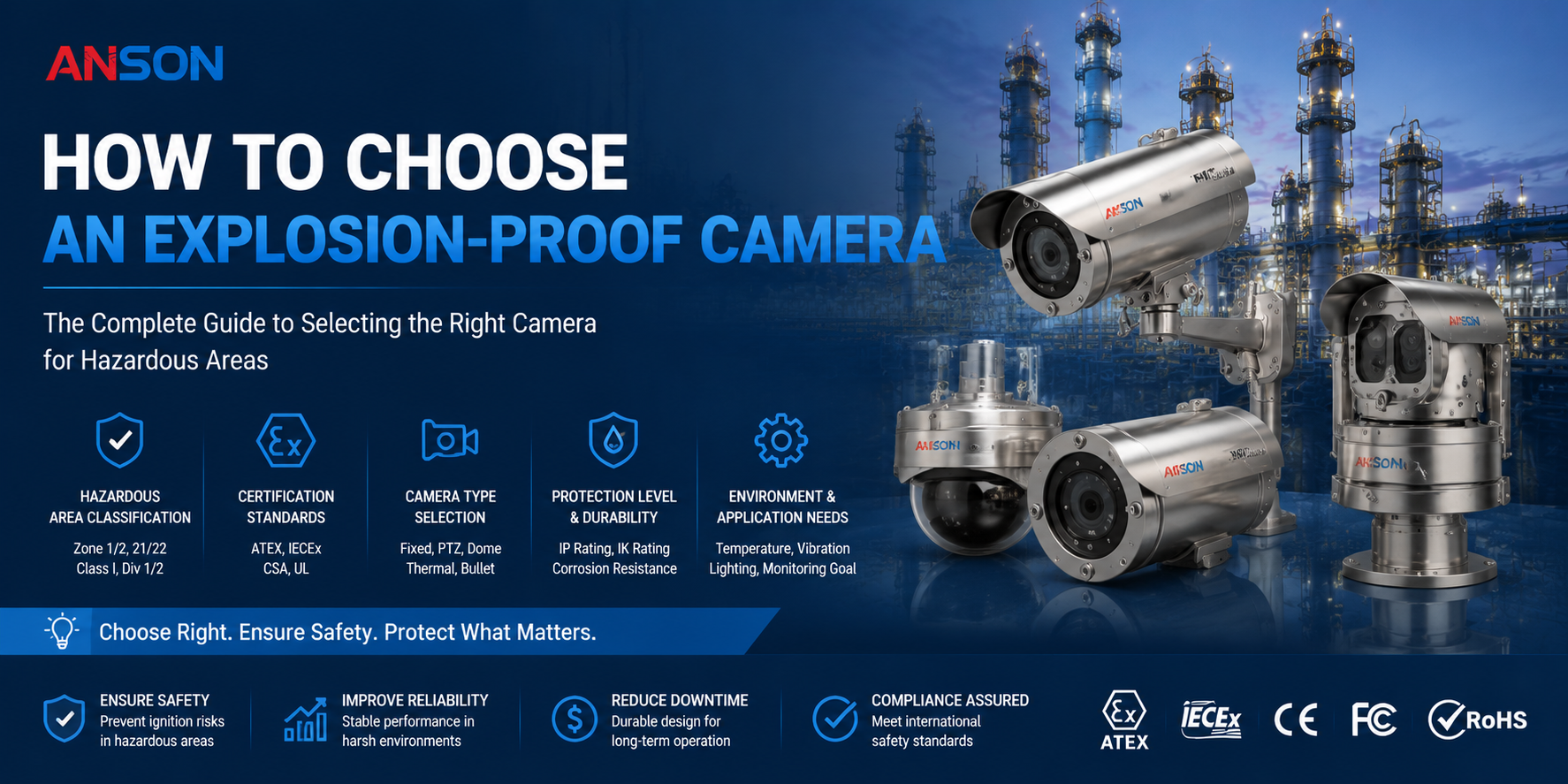
What Is an Explosion Proof Camera?
An Explosion Proof Camera is a surveillance device enclosed within a specially designed housing capable of containing any internal spark, heat, or explosion and preventing it from igniting hazardous substances in the surrounding environment.
These cameras are commonly certified according to:
- ATEX Certification
- IECEx Certification
- Class I Division 1 & Division 2 Standards
- المنطقة 1, المنطقة 2, المنطقة 21, والمنطقة 22 Requirements
Explosion proof cameras are widely used for:
- Oil Refineries
- Petrochemical Plants
- Offshore Oil Platforms
- منشآت الغاز الطبيعي المسال
- Chemical Manufacturing Plants
- Marine Vessels
- مواقع التعدين
- Tank Farms
- Fuel Storage Facilities
خطوة 1: Identify Your Hazardous Area Classification
The first step is determining the hazardous area classification where the camera will be installed.
Zone Classification
المنطقة 0
Explosive gas atmosphere is continuously present.
المنطقة 1
Explosive atmosphere is likely to occur during normal operation.
المنطقة 2
Explosive atmosphere is unlikely to occur and only exists for a short period.
Dust Classification
المنطقة 20
Combustible dust continuously present.
المنطقة 21
Dust likely present during normal operation.
المنطقة 22
Dust rarely present.
Most industrial surveillance projects require cameras certified for:
- المنطقة 1 & المنطقة 2
- المنطقة 21 & المنطقة 22
Always ensure the camera certification matches the site classification.
خطوة 2: Verify ATEX and IECEx Certifications
Certification is one of the most important considerations.
A reliable Explosion Proof Camera should comply with internationally recognized standards, including:
ATEX
Required for the European market.
IECEx
Accepted globally and widely specified by EPC contractors and oil companies.
Class I Division Standards
Commonly required in North America.
When evaluating products, request:
- ATEX Certificate
- IECEx Certificate
- Test Reports
- Declaration of Conformity
Choosing certified equipment helps avoid compliance risks and project approval delays.
خطوة 3: Choose the Right Camera Type
Different applications require different camera designs.
Explosion Proof Fixed Bullet Camera
Best for:
- Perimeter Monitoring
- Entry Gates
- Loading Areas
- Pipelines
Advantages:
- Cost-effective
- Easy installation
- Continuous monitoring
كاميرا PTZ مقاومة للانفجار
Best for:
- Large industrial sites
- Tank farms
- Offshore platforms
- Port facilities
Advantages:
- 360° continuous rotation
- Optical zoom
- Remote control
- Wide area coverage
كاميرا حرارية مضادة للانفجار
Best for:
- Fire prevention
- Gas leak detection
- Equipment temperature monitoring
- Night surveillance
Advantages:
- Detects heat instead of visible light
- Works in complete darkness
- Early fire detection capability
Explosion Proof Dome Camera
Best for:
- Smaller size requirements application
- Indoor use
Advantages:
- Small size , light weight
- Works in complete darkness
- Can use fixed lens or motorized lens for narrow view angle or wide angle
خطوة 4: Consider Image Resolution
Higher resolution provides more detail and improves incident investigation.
Recommended options:
2ميجا بكسل (1080P)
Suitable for:
- General monitoring
- Small industrial sites
4ميجا بكسل
Suitable for:
- Medium-sized facilities
- Better facial and object recognition
4K Ultra HD
Suitable for:
- Critical infrastructure
- Large hazardous areas
- Security-sensitive projects
For new projects, 4MP or 4K cameras are generally recommended.
خطوة 5: Evaluate Optical Zoom Requirements
If monitoring long distances, optical zoom becomes essential.
Typical options:
- 10x Zoom
- 20x Zoom
- 25x Zoom
- 30x Zoom
- 33x Zoom
- 40x Zoom
Applications requiring long-range surveillance include:
- Offshore platforms
- Tank farms
- Marine ports
- Pipelines
- Border security
Optical zoom provides superior image quality compared to digital zoom.
خطوة 6: Assess Environmental Conditions
Hazardous industrial environments can be extremely challenging.
Consider the following:
Corrosion Resistance
Marine and offshore applications require:
- 316L Stainless Steel Housing
- Salt spray resistance
Temperature Range
Choose cameras capable of operating in:
- -40°C to +60°C
- Extreme desert environments
- Arctic conditions
Weather Protection
Recommended rating:
- IP66
- IP67
- IP68
This protects against:
- Dust
- Water
- Heavy rain
- Industrial contaminants
خطوة 7: Determine Night Vision Requirements
Many industrial facilities operate 24/7.
Consider:
Infrared Night Vision
Ideal for:
- Perimeter protection
- Yard surveillance
- Loading zones
Thermal Imaging
Ideal for:
- Complete darkness
- Fog
- Smoke
- Fire detection
Thermal cameras provide the highest level of night-time situational awareness.
خطوة 8: Evaluate Network and Integration Requirements
Modern industrial surveillance systems should integrate with:
- Video Management Systems (VMS)
- NVR Systems
- SCADA Platforms
- Industrial Control Systems
Key features to consider:
- ONVIF Compatibility
- H.265 Video Compression
- PoE Support
- Fiber Connectivity
- Remote Access
These features improve system scalability and reduce maintenance costs.
خطوة 9: Consider Additional Accessories
Explosion proof surveillance systems often require supporting accessories.
Common options include:
Explosion Proof Washer Tank
Keeps the camera window clean from:
- Salt deposits
- Dust
- Oil contamination
Explosion Proof Junction Box
Provides safe cable termination.
Explosion Proof Monitor
Allows operators to view surveillance feeds safely in hazardous areas.
Mounting Brackets
- Wall Mount
- Pole Mount
- Corner Mount
- Marine Mount
Choosing the right accessories improves system reliability and longevity.
خطوة 10: Select a Reliable Manufacturer
The manufacturer should offer:
- ATEX & IECEx Certifications
- Global Project Experience
- الدعم الفني
- OEM/ODM Services
- Fast Spare Parts Supply
- Long-Term Product Availability
Experienced manufacturers can also assist with:
- Hazardous Area Assessment
- Camera Selection
- System Design
- Project Documentation
Recommended Explosion Proof Camera Solutions
For Oil & منشآت الغاز
Recommended:
- كاميرا PTZ مقاومة للانفجار
- Thermal PTZ Camera
- Washer Tank System
For Offshore Platforms
Recommended:
- Marine-grade 316L Stainless Steel PTZ Camera
- 30x Optical Zoom
- Anti-corrosion Design
For Chemical Plants
Recommended:
- Fixed Explosion Proof Bullet Camera
- Explosion Proof Dome Camera
- Thermal Monitoring System
For Mining Sites
Recommended:
- High-Resolution PTZ Camera
- Thermal Imaging Camera
- Long-Range Zoom Solution
Conclusion
Choosing the right Explosion Proof Camera requires careful consideration of hazardous area classifications, certifications, environmental conditions, image quality, and application requirements.
Whether you need surveillance for an offshore platform, oil refinery, chemical processing plant, LNG facility, or mining operation, selecting a certified and reliable explosion proof camera system is essential for maintaining safety, الأمن, and regulatory compliance.
By evaluating your operational requirements and partnering with an experienced manufacturer, you can deploy a surveillance solution that delivers long-term performance in even the most demanding hazardous environments.
وي تشات
امسح رمز الاستجابة السريعة بواسطة وي تشات