 Fornecedor de Câmeras à Prova de Explosão

Introdução
In hazardous industrial environments such as oil refineries, plataformas offshore, plantas químicas, terminais de GNL, and mining sites, maintaining clear camera visibility is critical for safety and operational efficiency. No entanto, poeira, oil mist, salt spray, vapores químicos, and extreme weather conditions can quickly contaminate the camera lens, reducing image quality and compromising surveillance effectiveness.
Como resultado, operators may struggle to monitor critical processes and safety hazards in real time. To address this challenge, an Explosion Proof Water Spray Tank for PTZ Camera is specifically designed to provide automatic lens cleaning for explosion-proof cameras operating in hazardous locations.
Neste artigo, we will explain how an explosion-proof water spray system works, how to use it effectively, and why it has become an essential accessory for industrial surveillance systems.
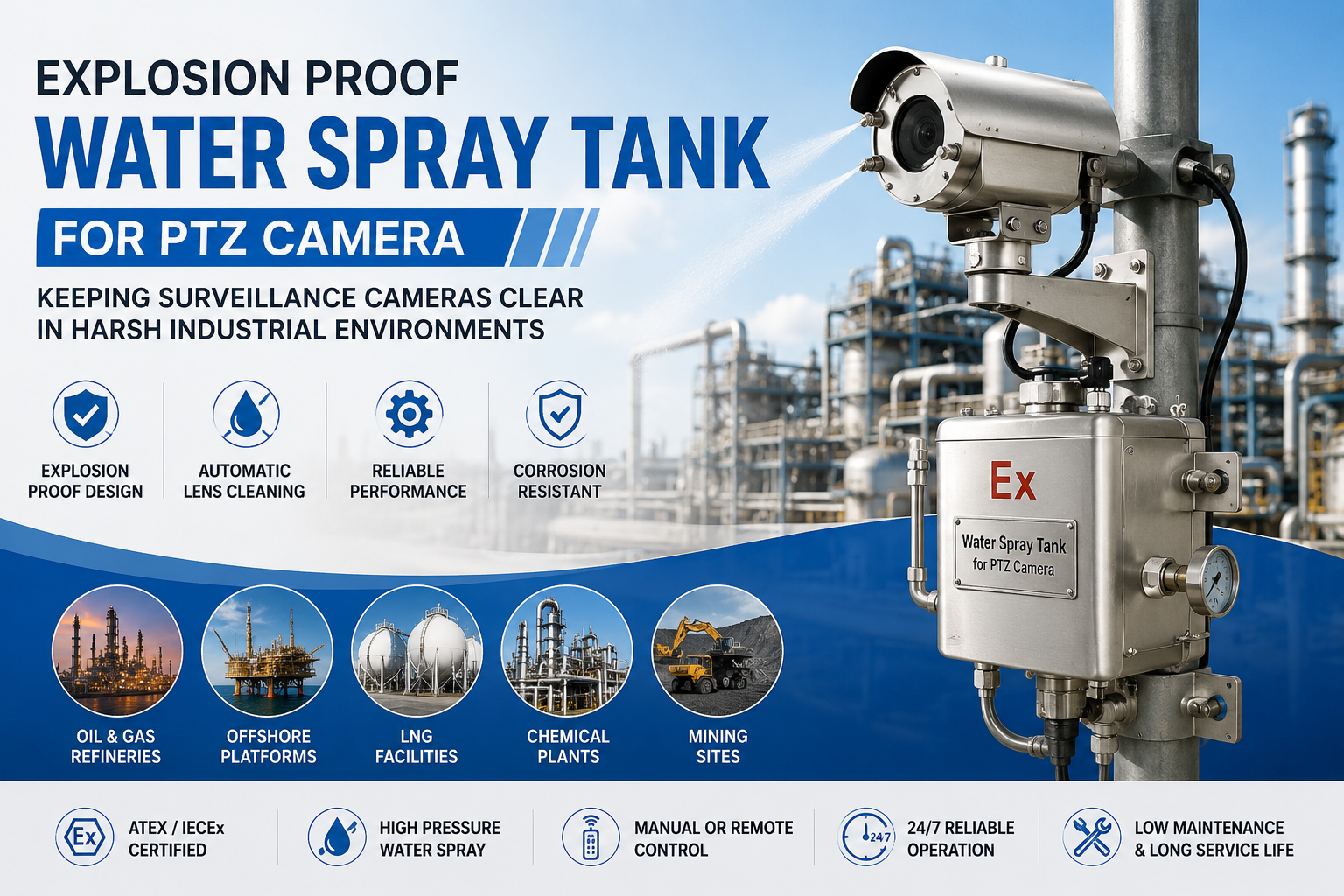
Explosion proof Water Spray Tank for CCTV PTZ Camera
What Is an Explosion Proof Water Spray Tank?
An Explosion Proof Water Spray Tank is a pressurized cleaning system designed to remove dust, oil residue, salt deposits, and other contaminants from the viewing window of an explosion-proof PTZ camera.
Typically, the system includes:
- Stainless steel water tank
- Explosion-proof control unit
- High-pressure spray nozzle
- Solenoid valve
- Tubing and fittings
- Automatic or manual cleaning control
When activated, the system sprays clean water onto the camera viewing window. Consequentemente, image clarity is restored without requiring maintenance personnel to enter hazardous areas.
Além disso, this automated cleaning process significantly reduces manual maintenance requirements and helps ensure uninterrupted surveillance.
Why Do Explosion Proof Cameras Need Water Spray Systems?
Industrial facilities expose surveillance cameras to severe environmental conditions. Portanto, maintaining a clean viewing window becomes essential for reliable monitoring.
1. Dust Accumulation
For example, mining operations, cement plants, and bulk material handling facilities generate significant airborne dust. Over time, these particles settle on the camera window and gradually obstruct visibility.
2. Oil Mist and Hydrocarbon Residue
Similarly, refineries and petrochemical plants often release oil particles that coat camera windows. Como resultado, image quality deteriorates and monitoring accuracy decreases.
3. Salt Corrosion
Meanwhile, offshore platforms and marine terminals are continuously exposed to salt-laden air. Consequentemente, salt deposits accumulate on camera housings and viewing windows, affecting surveillance performance.
4. Chemical Vapors
Além disso, chemical manufacturing facilities may expose cameras to corrosive vapors. These contaminants can create stubborn residues that reduce image clarity and accelerate equipment wear.
Without an effective cleaning system, operators may lose critical visual information precisely when it is needed most.
How Does an Explosion Proof Water Spray Tank Work?
The operating principle is straightforward yet highly effective.
Step 1: Water Storage
First, clean water is stored in a corrosion-resistant stainless steel tank.
Step 2: Pressure Generation
Próximo, the tank maintains sufficient pressure to deliver water through the cleaning nozzle.
Step 3: Spray Activation
Depending on the installation requirements, cleaning can be activated manually, automatically, or remotely from the control room.
Step 4: Lens Cleaning
Once activated, the nozzle directs a high-pressure water stream onto the camera viewing window, removing:
- Poeira
- Mud
- Salt crystals
- Oil film
- Chemical deposits
Como resultado, contaminants are quickly washed away without interrupting camera operation.
Step 5: Image Restoration
Finally, the camera regains a clear field of view for continuous monitoring.
Mais importante ainda, this process helps ensure reliable surveillance in critical industrial applications.
How to Use an Explosion Proof Water Spray Tank
Installation Procedure
First, mount the water tank near the explosion-proof PTZ camera.
Próximo, connect corrosion-resistant tubing between the tank and spray nozzle.
After that, install the spray nozzle and position it to fully cover the camera window.
Subsequently, connect the system to the control panel or monitoring system.
Finally, test the cleaning cycle to verify proper spray coverage and cleaning effectiveness.
Best Practices for Daily Operation
To maximize system performance, several best practices should be followed.
Use Clean Water
Ideally, filtered or demineralized water should be used. This helps prevent mineral buildup on the viewing window and extends system lifespan.
Schedule Regular Cleaning
Além disso, cleaning intervals should be adjusted according to environmental conditions.
For example:
- Offshore platforms: Every 4–6 hours
- Refinarias: Every 8–12 hours
- Mining facilities: Every 1–2 hours
Monitor Tank Pressure
Além disso, maintaining adequate tank pressure is essential for effective cleaning performance.
Inspect Nozzles Periodically
Finally, spray nozzles should be inspected regularly to ensure they remain free from blockages and operate efficiently.
By following these recommendations, operators can significantly improve surveillance reliability while reducing maintenance costs.
WeChat
Digitalize o Código QR com o WeChat