 Fournisseur de caméras antidéflagrantes

Caméra de four: High Temperature Furnace Monitoring System for Safe and Efficient Industrial Operations
Introduction
In modern industrial processes, maintenir une visibilité en temps réel à l'intérieur des fours à haute température est essentiel pour garantir la qualité du produit, l'efficacité opérationnelle, and workplace safety. Industries such as steel manufacturing, cement production, glass processing, power generation, and petrochemical refining all rely on furnaces operating at extremely high temperatures.
Cependant, direct observation of furnace conditions is often impossible due to intense heat, flames, dust, and hazardous gases. As a result, many facilities are turning to advanced Oven Camera Systems et High Temperature Furnace Monitoring Systems to achieve continuous visual monitoring without exposing personnel to dangerous environments.
In this article, we will explore how furnace camera systems work, their key benefits, and why they have become an indispensable tool in modern industrial operations.
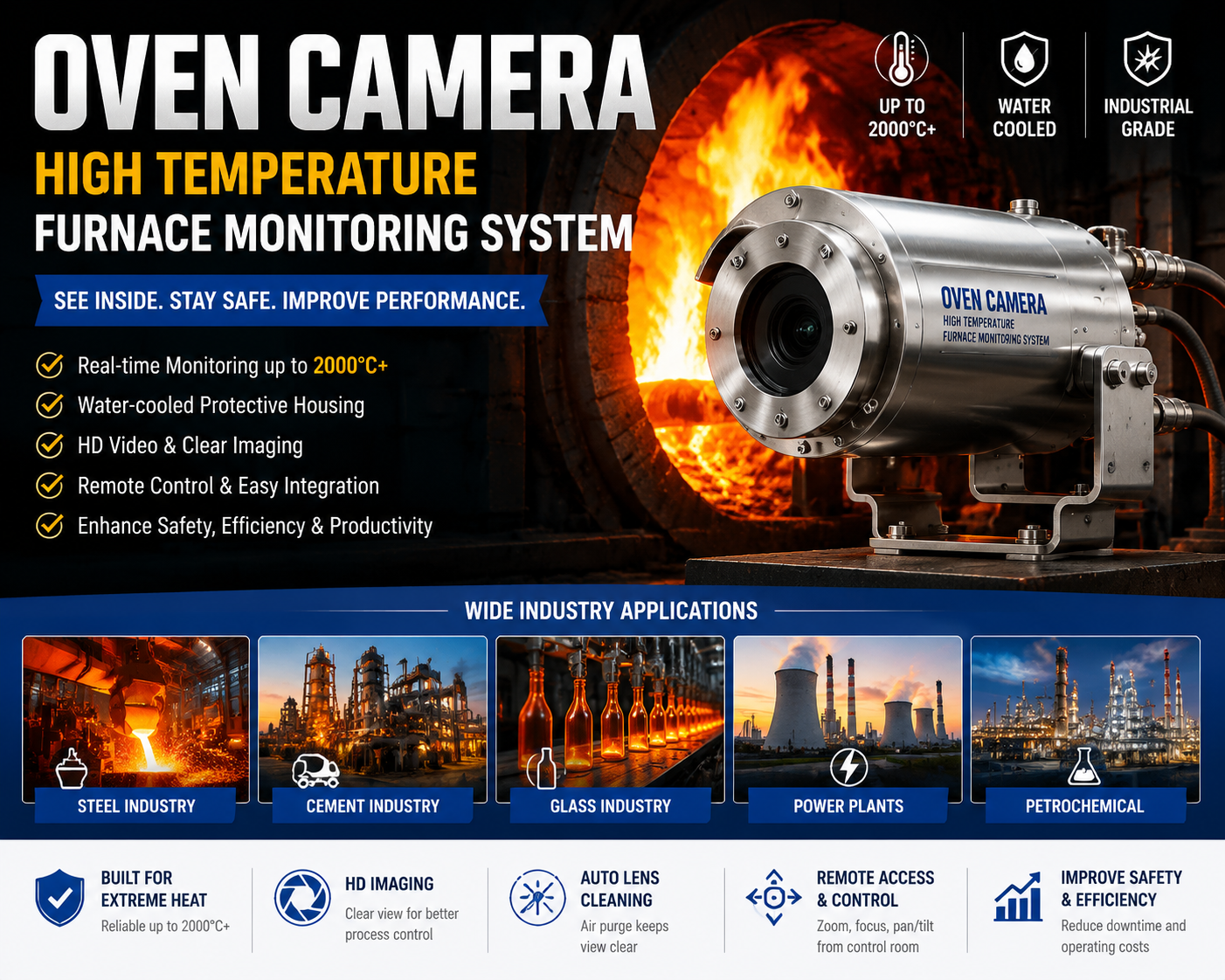
Système de surveillance de four à haute température
Furnace Camera System
What Is an Oven Camera System?
Une Caméra de four is a specially engineered industrial camera designed to provide real-time visual monitoring inside high-temperature furnaces, kilns, boilers, incinerators, and combustion chambers.
Unlike conventional cameras, high-temperature furnace cameras are equipped with:
- Water-cooled or air-cooled protective housings
- Heat-resistant optics
- Industrial-grade imaging sensors
- Automatic lens cleaning systems
- Remote monitoring capabilities
Consequently, these systems can operate reliably in environments where temperatures may exceed 1500°C (2732°F).
Other Cameras for different industrial monitoring
Why Is Furnace Monitoring Important?
Industrial furnaces are critical production assets. Par conséquent, any disruption can result in significant production losses and safety risks.
Improve Process Efficiency
Real-time furnace monitoring enables operators to observe:
- Flame patterns
- Material flow
- Combustion conditions
- Burner performance
As a result, process adjustments can be made immediately to optimize production efficiency.
Enhance Workplace Safety
Traditionally, operators needed to inspect furnaces manually through observation ports.
Cependant, exposure to extreme heat and hazardous gases creates significant safety concerns.
By using a furnace camera system, operators can monitor internal conditions remotely from a control room, significantly reducing personnel exposure to dangerous environments.
Reduce Unplanned Downtime
Furthermore, continuous monitoring allows operators to identify abnormalities before they escalate into major failures.
Examples include:
- Burner malfunctions
- Refractory damage
- Material blockages
- Excessive slag buildup
Consequently, maintenance can be scheduled proactively rather than reactively.
How Does a High Temperature Furnace Camera Work?
Although furnace environments are extremely harsh, modern furnace camera systems are designed to withstand these conditions through advanced cooling and protection technologies.
Step 1: Heat Protection
First, the camera is housed inside a robust stainless steel enclosure.
Typically, the enclosure features:
- Water cooling
- Air purging
- Thermal insulation
This ensures the internal camera temperature remains within safe operating limits.
Step 2: Continuous Viewing
Suivant, a heat-resistant optical window provides a clear view into the furnace.
Meanwhile, air purging systems help prevent dust and soot accumulation on the lens.
As a result, image quality remains stable even during continuous operation.
Step 3: Real-Time Video Transmission
The captured images are transmitted to:
- Control rooms
- SCADA systems
- Distributed Control Systems (DCS)
- Industrial monitoring platforms
Operators can therefore monitor furnace conditions 24/7 without interrupting production.
Key Features of Modern Furnace Monitoring Systems
High Temperature Resistance
One of the most important characteristics is the ability to operate in extreme heat environments.
Depending on the application, furnace camera systems can withstand temperatures ranging from:
- 1000°C
- 1200°C
- 1500°C
- 2000°C+
Applications of Oven Camera Systems
Steel Industry
Steel plants use furnace cameras to monitor:
- Blast furnaces
- Electric arc furnaces
- Reheating furnaces
- Continuous casting operations
Cement Industry
Cement manufacturers deploy kiln cameras for:
- Rotary kiln flame monitoring
- Clinker production control
- Combustion optimization
Glass Manufacturing
Glass plants utilize furnace cameras to observe:
- Glass melting processes
- Furnace temperature distribution
- Material flow conditions
Power Plants
Boiler cameras are commonly installed in:
- Coal-fired power stations
- Biomass plants
- Waste-to-energy facilities
These systems help optimize combustion efficiency while reducing emissions.
Petrochemical Industry
Refineries and petrochemical facilities use furnace monitoring systems to improve process visibility and ensure safe operation.
Applications include:
- Cracking furnaces
- Process heaters
- Reforming units
Benefits of Installing a Furnace Monitoring System
Better Product Quality
Real-time visual feedback allows operators to maintain consistent process conditions.
As a result, product quality improves significantly.
Increased Operational Safety
Remote monitoring minimizes worker exposure to hazardous environments.
Most importantly, this reduces the risk of workplace accidents.
Lower Maintenance Costs
By identifying issues early, facilities can avoid costly emergency repairs.
Consequently, maintenance budgets can be optimized.
Improved Energy Efficiency
Accurate combustion monitoring helps reduce fuel consumption and improve furnace performance.
Par conséquent, operating costs are lowered while sustainability goals are supported.
Choosing the Right Oven Camera System
Before selecting a furnace monitoring solution, consider the following factors:
Operating Temperature
Ensure the system is designed for your maximum furnace temperature.
Cooling Method
Options include:
- Water-cooled furnace cameras
- Air-cooled furnace cameras
Viewing Distance
Select appropriate optics based on furnace size and monitoring requirements.
Environmental Conditions
Evaluate exposure to:
- Dust
- Ash
- Corrosive gases
- Vibration
A modern Oven Camera High Temperature Furnace Monitoring System provides industrial operators with the visibility needed to improve safety, efficiency, and process control in extreme environments.
Whether installed in steel plants, cement kilns, glass furnaces, power boilers, or petrochemical facilities, these systems deliver continuous real-time monitoring while reducing downtime and maintenance costs.
Ultimately, investing in a reliable furnace camera solution helps manufacturers achieve safer operations, better product quality, and higher overall productivity.
FAQ
What temperature can a furnace camera withstand?
Depending on the design, industrial furnace cameras can monitor environments exceeding 2000°C through specialized cooling systems.
What industries use oven camera systems?
Steel, cement, glass, power generation, petrochemical, waste-to-energy, and mining industries commonly use furnace monitoring systems.
Can furnace cameras be integrated with SCADA systems?
Oui. Most modern furnace camera systems support integration with SCADA, DCS, and PLC platforms.
What is the difference between a furnace camera and a thermal camera?
A furnace camera provides direct visual monitoring inside the furnace, while a thermal camera measures surface temperatures using infrared technology.
How does the camera survive extreme temperatures?
Protective housings, water cooling, air purging, and heat-resistant materials keep the camera operating safely in high-temperature environments.
WeChat
Scannez le code QR avec WeChat