 Explosionsgeschützte Kameras

Ofenkamera: High Temperature Furnace Monitoring System for Safe and Efficient Industrial Operations
Einführung
In modern industrial processes, maintaining real-time visibility inside high-temperature furnaces is essential for ensuring product quality, operational efficiency, and workplace safety. Industries such as steel manufacturing, cement production, glass processing, power generation, and petrochemical refining all rely on furnaces operating at extremely high temperatures.
However, direct observation of furnace conditions is often impossible due to intense heat, flames, Staub, and hazardous gases. As a result, many facilities are turning to advanced Oven Camera Systems und High Temperature Furnace Monitoring Systems to achieve continuous visual monitoring without exposing personnel to dangerous environments.
In this article, we will explore how furnace camera systems work, their key benefits, and why they have become an indispensable tool in modern industrial operations.
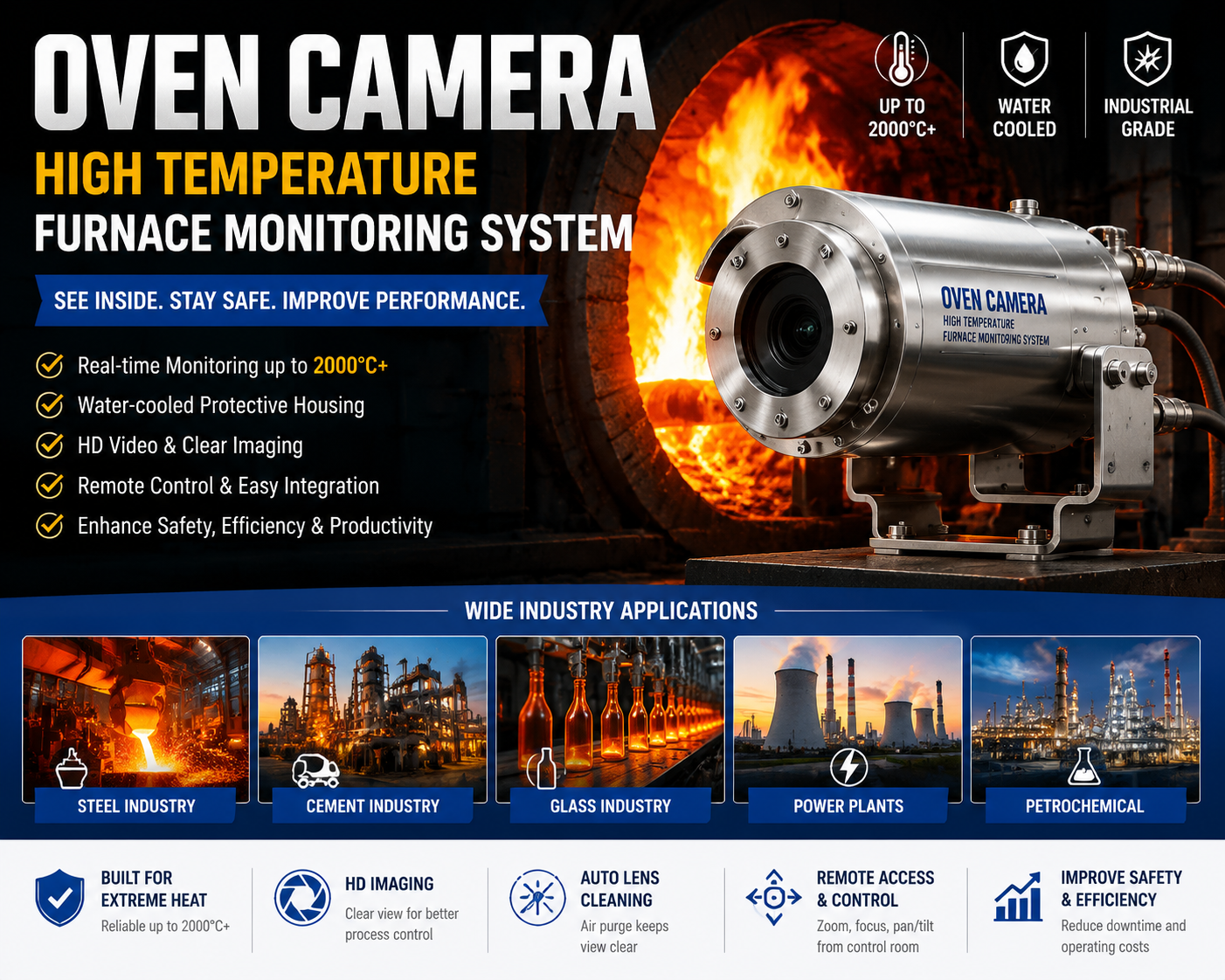
Überwachungssystem für Hochtemperaturofen
Furnace Camera System
What Is an Oven Camera System?
Ein Ofenkamera is a specially engineered industrial camera designed to provide real-time visual monitoring inside high-temperature furnaces, kilns, boilers, incinerators, and combustion chambers.
Unlike conventional cameras, high-temperature furnace cameras are equipped with:
- Water-cooled or air-cooled protective housings
- Heat-resistant optics
- Industrial-grade imaging sensors
- Automatic lens cleaning systems
- Remote monitoring capabilities
Daher, these systems can operate reliably in environments where temperatures may exceed 1500°C (2732°F).
Other Cameras for different industrial monitoring
Why Is Furnace Monitoring Important?
Industrial furnaces are critical production assets. Daher, any disruption can result in significant production losses and safety risks.
Improve Process Efficiency
Real-time furnace monitoring enables operators to observe:
- Flame patterns
- Material flow
- Combustion conditions
- Burner performance
As a result, process adjustments can be made immediately to optimize production efficiency.
Enhance Workplace Safety
Traditionally, operators needed to inspect furnaces manually through observation ports.
However, exposure to extreme heat and hazardous gases creates significant safety concerns.
By using a furnace camera system, operators can monitor internal conditions remotely from a control room, significantly reducing personnel exposure to dangerous environments.
Reduce Unplanned Downtime
Darüber hinaus, continuous monitoring allows operators to identify abnormalities before they escalate into major failures.
Examples include:
- Burner malfunctions
- Refractory damage
- Material blockages
- Excessive slag buildup
Daher, maintenance can be scheduled proactively rather than reactively.
How Does a High Temperature Furnace Camera Work?
Although furnace environments are extremely harsh, modern furnace camera systems are designed to withstand these conditions through advanced cooling and protection technologies.
Step 1: Heat Protection
Zuerst, the camera is housed inside a robust stainless steel enclosure.
Typically, the enclosure features:
- Water cooling
- Air purging
- Thermal insulation
This ensures the internal camera temperature remains within safe operating limits.
Step 2: Continuous Viewing
Weiter, a heat-resistant optical window provides a clear view into the furnace.
Meanwhile, air purging systems help prevent dust and soot accumulation on the lens.
As a result, image quality remains stable even during continuous operation.
Step 3: Real-Time Video Transmission
The captured images are transmitted to:
- Control rooms
- SCADA systems
- Distributed Control Systems (DCS)
- Industrial monitoring platforms
Operators can therefore monitor furnace conditions 24/7 without interrupting production.
Key Features of Modern Furnace Monitoring Systems
High Temperature Resistance
One of the most important characteristics is the ability to operate in extreme heat environments.
Depending on the application, furnace camera systems can withstand temperatures ranging from:
- 1000°C
- 1200°C
- 1500°C
- 2000°C+
Applications of Oven Camera Systems
Steel Industry
Steel plants use furnace cameras to monitor:
- Blast furnaces
- Electric arc furnaces
- Reheating furnaces
- Continuous casting operations
Cement Industry
Zementhersteller setzen Ofenkameras ein für:
- Überwachung der Flamme im Drehofen
- Kontrolle der Klinkerproduktion
- Optimierung der Verbrennung
Glasherstellung
Glaswerke nutzen Ofenkameras, um zu beobachten:
- Glasschmelzprozesse
- Temperaturverteilung im Ofen
- Bedingungen des Materialflusses
Kraftwerke
Boiler-Kameras werden häufig installiert in:
- Kohlekraftwerken
- Biomasseanlagen
- Abfall-zu-Energie-Anlagen
Diese Systeme helfen, die Verbrennungseffizienz zu optimieren und gleichzeitig Emissionen zu reduzieren.
Petrochemische Industrie
Raffinerien und petrochemische Anlagen nutzen Ofenüberwachungssysteme, um die Prozesssichtbarkeit zu verbessern und einen sicheren Betrieb zu gewährleisten.
Anwendungen umfassen:
- Cracking-Öfen
- Prozessheizungen
- Reformierungseinheiten
Vorteile der Installation eines Ofenüberwachungssystems
Bessere Produktqualität
Echtzeit-Visuelles Feedback ermöglicht es den Bedienern, konsistente Prozessbedingungen aufrechtzuerhalten.
As a result, Die Produktqualität verbessert sich erheblich.
Erhöhte Betriebssicherheit
Fernüberwachung minimiert die Exposition von Arbeitern gegenüber gefährlichen Umgebungen.
Am wichtigsten, Dies reduziert das Risiko von Arbeitsunfällen.
Niedrigere Wartungskosten
Durch frühzeitige Erkennung von Problemen, können teure Notfallreparaturen vermieden werden.
Daher, Wartungsbudgets können optimiert werden.
Verbesserte Energieeffizienz
Genaues Brennüberwachungsmonitoring hilft, den Brennstoffverbrauch zu senken und die Leistung des Ofens zu verbessern.
Daher, Betriebskosten werden gesenkt, während Nachhaltigkeitsziele unterstützt werden.
Die richtige Ofenkamera auswählen
Bevor Sie eine Lösung zur Überwachung des Ofens auswählen, berücksichtigen Sie die folgenden Faktoren:
Betriebstemperatur
Stellen Sie sicher, dass das System für Ihre maximale Ofentemperatur ausgelegt ist.
Kühlungsmethode
Optionen sind:
- Wassergekühlte Ofenkameras
- Luftgekühlte Ofenkameras
Sichtabstand
Wählen Sie geeignete Optiken basierend auf der Ofengröße und den Überwachungsanforderungen.
Umweltbedingungen
Bewerten Sie die Exposition gegenüber:
- Staub
- Asche
- Korrosive Gase
- Vibration
Ein modernes Ofenkamera-Hochtemperatur-Ofenüberwachungssystem bietet Industriebetreibern die Sichtbarkeit, die erforderlich ist, um die Sicherheit, Effizienz, und Prozesskontrolle in extremen Umgebungen zu verbessern.
Ob installiert in Stahlwerken, Zementöfen, Glasöfen, Kesselanlagen, oder petrochemischen Anlagen, diese Systeme liefern kontinuierliche Echtzeitüberwachung und reduzieren gleichzeitig Ausfallzeiten und Wartungskosten.
Letztendlich, hilft die Investition in eine zuverlässige Ofenkameralösung Herstellern, sicherere Abläufe, bessere Produktqualität, und höhere Gesamtproduktivität zu erreichen.
FAQ
Welche Temperatur kann eine Ofenkamera aushalten?
Je nach Design, industrial furnace cameras can monitor environments exceeding 2000°C through specialized cooling systems.
What industries use oven camera systems?
Steel, cement, glass, power generation, Petrochemie-, waste-to-energy, and mining industries commonly use furnace monitoring systems.
Can furnace cameras be integrated with SCADA systems?
Ja. Most modern furnace camera systems support integration with SCADA, DCS, and PLC platforms.
What is the difference between a furnace camera and a thermal camera?
A furnace camera provides direct visual monitoring inside the furnace, while a thermal camera measures surface temperatures using infrared technology.
How does the camera survive extreme temperatures?
Protective housings, water cooling, air purging, and heat-resistant materials keep the camera operating safely in high-temperature environments.
WeChat
Scannen Sie den QR-Code mit WeChat